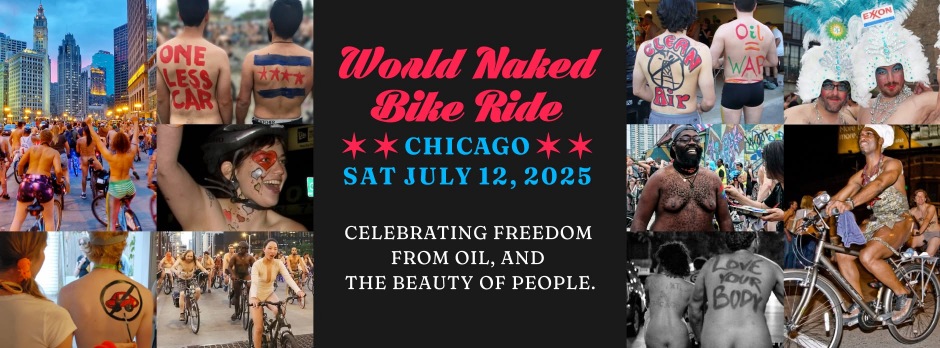
World Naked Bike Ride Generalized but Specific How To Guide and Plan
Andrew Bedno - World Naked Bike Ride Chicago - 2009.01.20
The following is a generalized version of Chicago's annual production checklist for our running of the World Naked Bike Ride.
Since it has gotten rather long, I'll reiterate the absolute keys for first-timers:
The World Naked Bike Ride coming to / happening in a city I believe typically goes through several distinct phases over the course of years. This was true for Chicago, and I gather from reading was similar in others. I mention this so new rides can address appropriate needs and expectations.
First year and before is usually championed by an individual, and a few dear cycling friends. This is MUCH easier if a Critical Mass monthly ride already exists. If it doesn't, that should be established as well, perhaps first. Champions probably are notably comfortable with their bodies, and local nudists may aid. First year may simply be flyer printing, word-of-mouth, and under a dozen turnout. BUT AT LEAST precedence is established.
Second and third years are about familiarizing the city and cycling community with that the event will happen, and has happened before. City becomes familiar with the name. Helps if prior year photos are posted and good painting was done. Do heavier flyer printing, word of mouth, and PR. For rides under a hundred, route can be informal and start/end as simple as someone's yard.
By third year, cyclists+hipsters will expects the event in advance. Press will readily publish it in event listings and may ask for photos. Expect several times the prior years riderships; in smaller cities be prepared for dozens, larger should hit hundreds with proper publicity. At this level a planned route is required, start/end points become significant questions, and legal observers and police liaison should be engaged.
By fourth year the event is a serious sustained production, where all the matter in this How To comes to bear, and a considerable team of facilitators is required.
As of fifth year Chicago ceased pursuing increased ridership. With the mass long enough to fill the biggest streets for miles, we have the luxury of concentrating on safety and message, and the new challenges of such a colossus.
Chicago has been notably successful due to the current good level of organization built through experience. BUT another key to success is that work is appropriate to development year. Chicago currently pursues an optimized balance of maximized safety, message, fun and comfort, with minimized friction, management and cost. A first few years ride however could simplify down to get lots of riders, have fun, and don't get arrested.
FIRST-TIMERS:
JANUARY:
FEBRUARY:
MARCH:
APRIL:
MAY:
JUNE:
DAY OF:
AFTER:
Actual production supplies checklist formerly used by Chicago:
Site:
Concessions:
Setup:
Admin:
The following is a generalized version of the actual donation gift items and quantities consumed by Chicago's ride. These were given away on site, some on honor system, at a donations table. For other cities the quantitites can be scaled, but the items are sound.
Also gifts for leading volunteers:
Production staffing for a large event can be seen as several largely independent teams. The following are titles Chicago uses, their descriptions, and approximate number on each in 2008:
The following are typical pre-ride "stations" (activity areas) during the gathering phase of Chicago's events.
Check-In. Gate. Support.
Donations and concessions table.
Roaming donations and concessions.
Body painters.
Body painting DIY.
Drum Circles.
Bands.
Music Trailers.
Bike decorating.
Coolest bike contest.
Roaming photographer(s).
Stationary photographe(s)r.
Autographable event banner.
Bike related art.
Performance: joust, extreme, tall, dance, ...
Play: chalk, hoops, poi, frisbee, ...
Water. Snacks.
Potty.
Major subjects related to body painting for the World Naked Bike Ride Chicago.
Newbies, please visit the example photos page.
Supplies for the do-it-yourself painting area:
Palmer standard colors, 2oz, $1.85
Buying criteria:
Containers per painter = Number of hours * number of paintings per hour / paintings per container
( 3 * less than 20 ) / more than 20 = less than 3 = 1-3 bottles per painter
Therefore one bottle of each color for each painter will well more than suffice.
Black
Blue
Brown
Green
Orange
Pink
Purple
Red
Turquise
White
Yellow
Magenta (not available)
Artists planning to personally paint themselves and/or others should buy better. Spend a few dozen dollars on professional grade assortments from Snazaroo or Wolfe Brothers or Mehron, available at good costume shops such as Fantasy HQ.
Introductory face painting tips for the experienced artist. Andrew Bedno - 2008.09.24
These hints presume you can already paint with acrylics and render most any form on demand, such as flowers, planets, buildings...
As an example, here's my (outdated) online face painting flyer: http://bedno.com/drizzle/Andrew_Bedno-Face_Painting.pdf
There’s some detailed pictures of paints I’ve tried here: http://bedno.com/photo.php?c=20080418&i=20
Also see notes for WNBR-C painting team.
Review WNBR hints page online.
Chicago after years of experience and pro discussions compromised down to Palmers brand to supply the do it yourself painters. Palmers is bottom of the line but an IMPORTANT grade up from simply using any non-toxic acrylic. Palmer's is designed for skin, handles well enough, and is available in large bottles inexpensively. As with most brands, the red may stain, and there is a very low but potential risk of allergic reaction. Artists planning to personally paint themselves and/or others should buy better. Spend a few dozen dollars on professional grade assortments from Snazaroo or Wolfe Brothers or Mehron, available at good costume shops such as Fantasy HQ.
Chicago also compromised down to mostly foam brushes, from 0.5" to 3". These work well enough for broad and high volume and DIY. Altering angle with these can give any stroke width. Plus a selection of inexpensive conventional synthetic fine paintbrushes (#2-6), but good ones, not dollar store. Artists should bring their own.
To create a a painting area set out paints and brushes. Sometimes cheap tarps where necessary, but for best results paint where everything including tables chairs and ground may get splashed. Add stacks of paper cups, some plates, rolls of paper towel, and some water bottles.
To handle high volume, assign leaders, and define specific recommended artwork (as opposed to anything anyone wants). Hold back refill quantitites of all supplies, rather than setting everything out at first.
Seek out actual working face/body paint artists, such as clowns. Especially seek out air-brush body painter artists (sometimes overlaps with tattoo). Working body painters will often bring their own professional grade paints and favorite brushes. And may hope for some compensation. Such professional artists may volunteer for the cause or for kicks, and can be encouraged to hand out cards as enticement, or may reasonably solicit tips.
Radios / walkie-talkies / other ride-day live communications solutions is the subject of extensive discussion. Bottom line, don't skimp. If a ride is tiny to small just yell or use phones. At the 150-500 level GOOD walkie talkies are a BIG help. Buy more than two of the highest power and distance allowed by law. At the 1000 plus level we're debating PTT rentals as the only reliable for distance.
More details will be posted here when finalized.
Collected notes and links on two way radio technologies: [wikipedia]
Smartphone PTT Apps:
Several "Push To Talk" radio simulating apps are available for smartphones, and compatible across all common makes and models. There's a review of the best here. We currently recommend Voxer. Voxer features real-time push-to-talk, also push notifications, message queuing, GPS, photo and text capabilities.
Rental:
PMR (Professional Mobile Radio) are available for event production rental from numerous local sources. Prices average over $20 per radio, for periods ranging from a day to a week. Not clear on if base station or repeater is required.
ActiveTrans recommends Communications Direct. Yolanda at 312-829-7770 quotes $15 each radio, headsets $2 each, $150 "repeater service". Pickup Friday after 10am, return Monday by 4:30pm, 710 N. Aberdeen. 8 radios ($120) + 8 headsets ($16) + repeater ($150) = $286.
Others: A.V. Chicago, BearCom, AMJ events
PMR: [wikipedia]
Professional Mobile Radio / Private Mobile Radio and land mobile radio (LMR) are field radio communications systems which use portable, mobile, base station, and dispatch console radios. Operation of PMR radio equipment is based on various advanced standards, designed for dedicated use by specific organizations, or for general commercial use. Typical examples are the radio systems used by police forces and fire brigades. Professional mobile radio systems provide large coverage area using base station, tower, repeater or cell systems. Stringent licensing is required.
GMRS: [wikipedia]
General Mobile Radio Service is an FM system in the 462MHz range (shared with FRS). Allowed power up to 5W. Requires a simple license in U.S. Channels 1-7 are solely for use with the FRS/GMRS system. Channels 8-14 are solely for FRS and 15-22 is for GMRS. Depending on terrain, these radios can have a much broader range than FRS, possibly extending a few miles.
FRS: [wikipedia]
The Family Radio Service provides a series of 14 channels in the 462 and 467 MHz range. Using frequencies in the UHF band, and FM, gives less interference than CBs. These radios require no special license, but are low power and short ranged.
FHSS: [wikipedia]
Frequency Hopping Spread Spectrum combines digital technology with narrow band FM modulation technique in the ISM band (900 MHz frequencies). Ensure for maximum usable range within a given dB power budget with the added benefit privacy provided by the frequency hopping spread spectrum algorithm. The pseudo-random drawing of the hopping frequencies spreads the total signal power equally over the entire bandwidth of the RF spectrum used, which minimizes interference between simultaneous independent users. Under identical conditions FHSS will have usable talk range equal to or greater than other GMRS radios. Requires no license and can be used at any age and for any purpose.
CB: [wikipedia]
Citizens Band is a largely obsolete, now hobbyist and specialty standard, functionally overlapping GMRS, but capable of longer distance through large antennas and illegal amplifiers. 40 Channels, 4 watts, 26.965-27.405 MHz, 162.400-162.550 MHz, AM modulation. The maximum legal CB power output level, in the U.S., is four watts for AM and 12 watts (peak envelope power or "PEP") for SSB, as measured at the antenna connection on the back of the radio. Although licenses are required, eligibility is simple.
Real World Ranges:
For CB, FRS, GMRS and MURS Radios.
My personal practical comparison of highest legal power GMRS and FHSS radios found identical range (just over a mile straight), though FHSS was slightly less static-y nearing maximum distance.
In testing, straight line (though on a hilly street), voice was VERY clear on both at half a mile, still very intelligible at 3/4, still usable at one mile, unintelligible at 1.2 miles, and no signal at all after 1.3 miles.
Worse still, the slightest angle, where signal would have to pass through buildings, radically lessened the distance. At just one block over from straight line, voice was usable at a half mile or closer, but became unintelligible only slightly further.